

Movement
Foundations
Deconstructing human geometry within the wild geography of Indonesia.
Natural athletics is not about rigid repetition. It is the art of adapting fundamental movement patterns—squats, hinges, pushes, and pulls—to the unpredictable surfaces of volcanic rock, jungle roots, and coastal shorelines.
The Hierarchy of Action
01. The Squat
The baseline for lower body power and vertical displacement. In natural environments, the squat adapts to uneven terrain, requiring ankle mobility to manage slopes and rocky steps.
02. The Hinge
Posterior chain engagement. It is the movement of lifting, jumping, and stabilizing. It protects the lower back by utilizing the powerful musculature of the glutes and hamstrings.
03. The Push
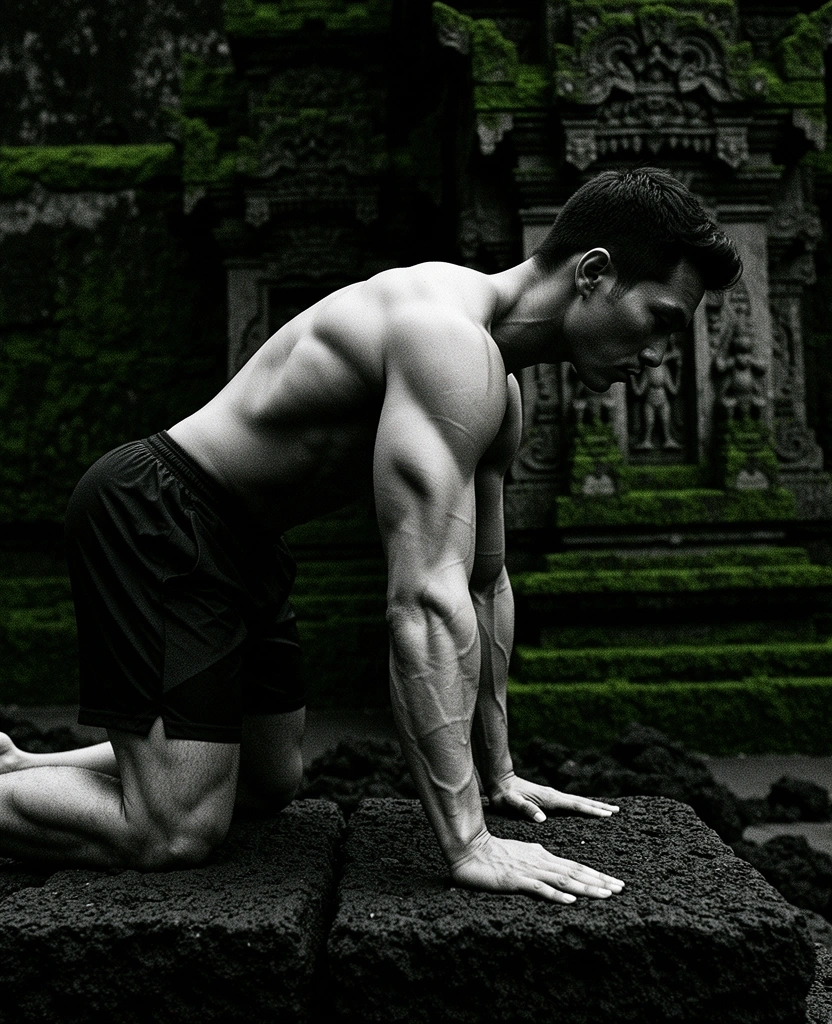
Moving force away from the core. Whether it is a ledge dip on a stone wall or a push-up on a horizontal branch, pushing builds upper body resilience and shoulder stability.
04. The Pull
Closing the distance between the body and an object. Pulling mechanics are vital for climbing and navigating vertical obstacles, emphasizing grip strength and back endurance.
"Training starts with bare-foot stability and ankle mobility to ensure a solid foundation. We identify mobility bottlenecks before adding intensity."
Mechanical Integrity: The Hinge
1 Vertical Alignment
Maintain a neutral spine. Mentally align your ear, shoulder, and hip. This kinetic chain assessment ensures the load is borne by the muscles, not the joints.
2 Hip Recess
Imagine a wall behind you. Reach for it with your glutes while keeping your shins as vertical as possible. This stretches the hamstrings under tension.
3 Core Engagement
Brace the abdominal wall before the movement begins. This creates internal pressure, stabilizing the lumbar spine during the descent.
Common Mistake: "Squatting the hinge"—letting the knees track forward too far, which shifts the emphasis away from the posterior chain.
Mapping the Territory
The world is your gym. Learn to identify safe objects in the Indonesian landscape to translate bodyweight basics into outdoor athletics.
Tree Branches
Ideal for pull-ups and hangs. Ensure the branch is alive (not brittle) and at least the thickness of your forearm before loading.
- Pull-up
- Scapular Hang
Stone Ledges
Natural basalt ledges serve as platforms for dips, elevated push-ups, or step-ups. Check for moss to avoid slipping.
- Ledge Dips
- Incline Push-ups
Grass Slopes
The uneven nature of a hillside forces the stabilizer muscles of the ankles and core to work harder than on flat pavement.
- Hill Sprints
- Side Lunges
Ready to Move?
The humidity of the Indonesian climate requires a deliberate warm-up to prepare the joints for load. Start with our 10-minute ground-up sequence before your session.
Ankle Rotations
10 repetitions each side for lateral stability on uneven basalt.
Deep Squat Prying
Hold for 60 seconds, gently shifting weight to open the hip capsules.
Thoracic Rotations
Essential for shoulder health before any pull-up or push-up movement.

Current humidity: High. Adjust intensity during peak sun hours.
The Ground-Up Approach
Our movement philosophy is built upon standard kinetic chain principles. We focus on natural human adaptability. For technical assistance or specific environment evaluations, please reach out to our team at [email protected].